

Updated 24 July 2026 by FRST Foundation
A bus stop can be difficult to read even for someone who sees it clearly. Routes may change, announcements may be missing, vehicles may stop in different places and crowds may block access. For a blind or visually impaired passenger, the biggest barrier is often inaccessible information—not an inability to travel independently.
If you notice someone who may need information, the most useful first step is not to grab or guide them. It is to introduce yourself and ask.
Begin with one clear question
Say: “Hello, would you like any help with the bus?” This gives the person your presence, the reason you are speaking and a real choice.
Do not assume that standing still means being lost. The person may be listening for traffic, waiting for a known driver, checking a phone or simply choosing where to stand.
Useful help at a bus stop
- Tell the person which bus has arrived and, if you know, its route or destination.
- Describe where the door has stopped using practical directions such as “about three steps ahead and slightly left.”
- Ask before guiding. If guidance is requested, offer your elbow and let the person hold your arm.
- Mention a high step, gap, kerb, queue barrier or obstacle before reaching it.
- Speak directly to the passenger, not only to a companion, conductor or driver.
- If the requested bus has not arrived, say so clearly rather than disappearing without explanation.
What not to do
- Do not pull a white cane or move it out of the way.
- Do not push someone towards a door or seat.
- Do not shout unless the environment genuinely requires it.
- Do not treat a refusal as confusion or ingratitude.
- Do not leave a person in a new location without saying where they are.
Respectful help protects agency. The goal is not to take control; it is to make information and assistance available.
Recognition can help the interaction begin
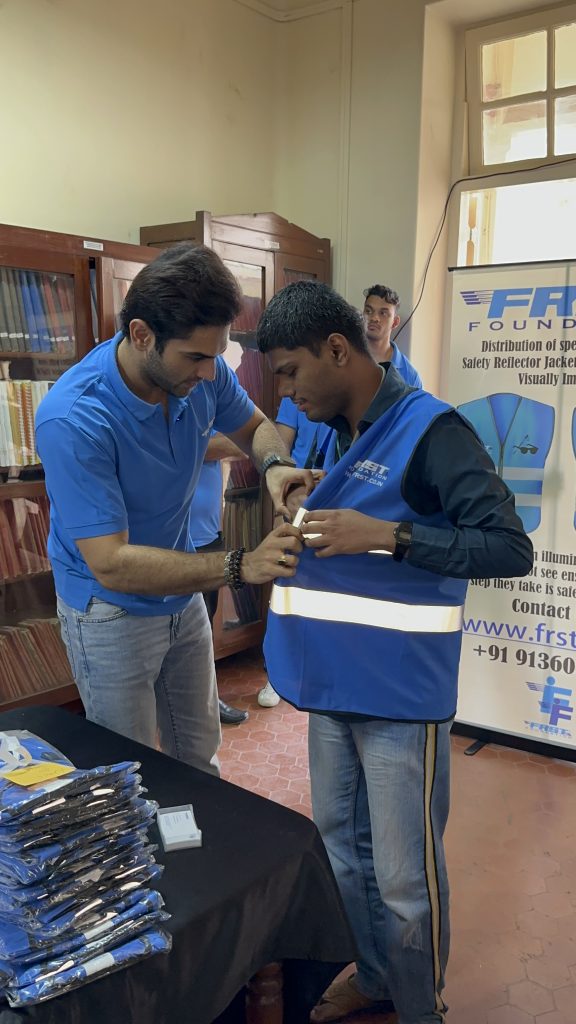
A sighted passenger may not always recognise that someone nearby is blind or visually impaired. FRST Foundation’s distinctive blue reflective jackets and raincoats are intended to provide a public recognition cue.
The cue should lead to four actions: notice, recognise, understand and ask. It is not permission to touch the wearer, and it does not mean that help is always required.
What the gear cannot replace
Reflective clothing does not improve vision, guarantee safety or replace accessible public transport. Reliable audio announcements, consistent stopping points, trained staff, unobstructed boarding areas and accessible route information remain essential.
Public kindness is valuable, but basic access should never depend entirely on whether a helpful stranger happens to be nearby.
For drivers, conductors and transport staff
- announce the route or destination clearly;
- allow enough time for safe boarding;
- answer questions directly and without impatience;
- describe available seating rather than physically placing someone;
- announce the requested stop with enough notice to prepare.
A simple public habit
You do not need specialist training to begin respectfully. Introduce yourself. Ask. Listen. Give clear information. Follow the person’s answer.
Read our full guide to respectful assistance in public, learn what FRST Blue means, or help more people recognise and respond.