
Updated 24 July 2026 by FRST Foundation
There is no single thing that every blind or visually impaired person in India needs. People have different levels of vision, different mobility methods, different work and family lives, and different preferences about assistance.
What the public can offer is simpler: accessible environments, accurate information, recognition without pity, and respectful help that begins with a question.
Start with agency, not assumptions
Blindness does not remove a person’s ability to decide where they are going, how they want to travel or whether they need help. A white cane, guide dog, companion or familiar route may already provide the information the person needs.
Do not grab someone’s arm, pull a cane, steer a person without warning or speak only to a companion. Introduce yourself, ask whether assistance is wanted, and follow the answer—even when the answer is no.
Accessible systems matter more than dramatic promises
Accessible transport, usable footpaths, audible and tactile information, readable digital services, inclusive education, employment and enforcement of accessibility standards all matter. No jacket, app or individual act of kindness replaces those systems.
That is why responsible disability work should explain the limits of every intervention. A practical tool can contribute to inclusion without being presented as a complete solution.
Recognition can improve the quality of public response
In a crowded station, bus stop, market or public event, a sighted person may not immediately recognise that someone nearby is blind or visually impaired. Without recognition, people may overlook a request, misunderstand a pause or offer help in an intrusive way.
A consistent public signal can make respectful interaction easier to begin. Recognition should lead to four actions: notice, recognise, understand and ask.
What FRST Blue does—and does not do
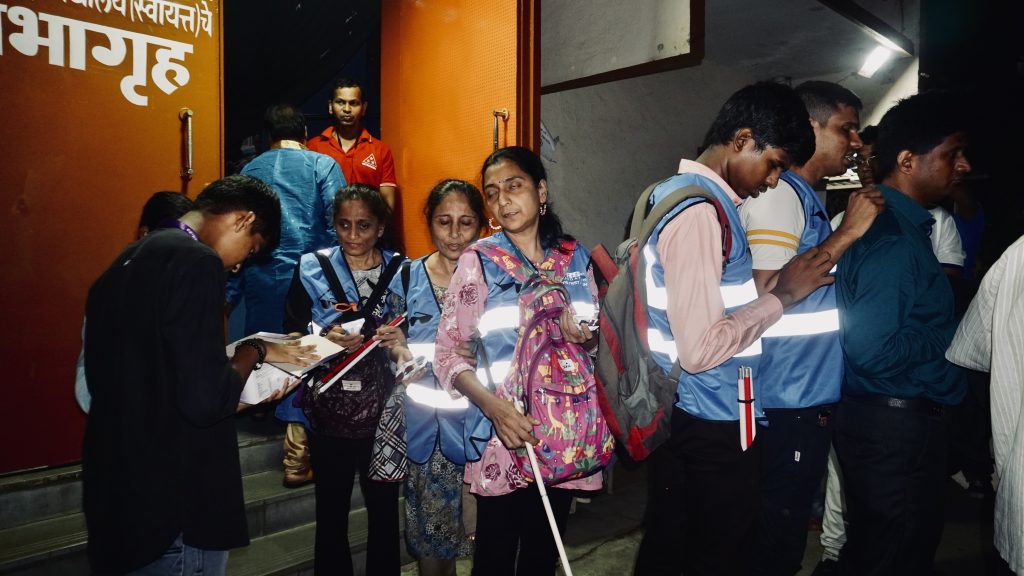
FRST Foundation distributes distinctive blue reflective jackets and raincoats free of cost to blind and visually impaired people through documented institutional initiatives.
The garments do not improve vision. They do not guarantee accident prevention, replace a white cane or accessible infrastructure, or give anyone permission to touch the wearer. They provide a visual cue that can help sighted people recognise the wearer and ask before helping.
Reflective material may also increase conspicuity when light reaches it, but FRST Foundation does not publish a fixed recognition distance for its garments because the exact products have not been independently distance-tested.
How to offer help respectfully
- Introduce yourself. A simple “Hello, would you like any help?” is enough.
- Ask, then wait. Do not assume that hesitation means helplessness.
- Use clear directions. Say “two steps to your left” rather than pointing or saying “over there.”
- Offer your elbow. If guiding is requested, let the person hold your arm instead of pulling them.
- Mention obstacles. Describe stairs, kerbs, narrow spaces or a change in surface before reaching them.
- Respect no. Declining assistance is a complete answer.
For more detail, read How to Help a Blind or Visually Impaired Person Respectfully in Public.
Evidence should be specific and dated
Through 19 July 2026, FRST Foundation documented 65 initiatives—more than three every month on average since the first documented initiative on 19 October 2024. Independently acknowledged distributions have reached at least 3,315 people with free recognition gear.
That documented reach is evidence of delivery; the Foundation does not claim that the gear prevented every risk or guarantees safety.
What the public can do today
- learn what FRST Blue is intended to signal;
- ask before helping;
- share accessible information rather than pity-based content;
- encourage organisations and public spaces to improve accessibility;
- support documented, transparent disability-inclusion work.
Learn what FRST Blue means, review our evidence, explore our documented impact, or support a future distribution.